Life Cycle Assessment (LCA) is the benchmark method for assessing the environmental impacts of a product, process, or service throughout its entire life cycle. Governed by ISO 14040 and ISO 14044 standards, it is based on a multi-criteria approach and identifies the stages, inputs, or technical choices that have the greatest impact, known as “environmental hot spots.”
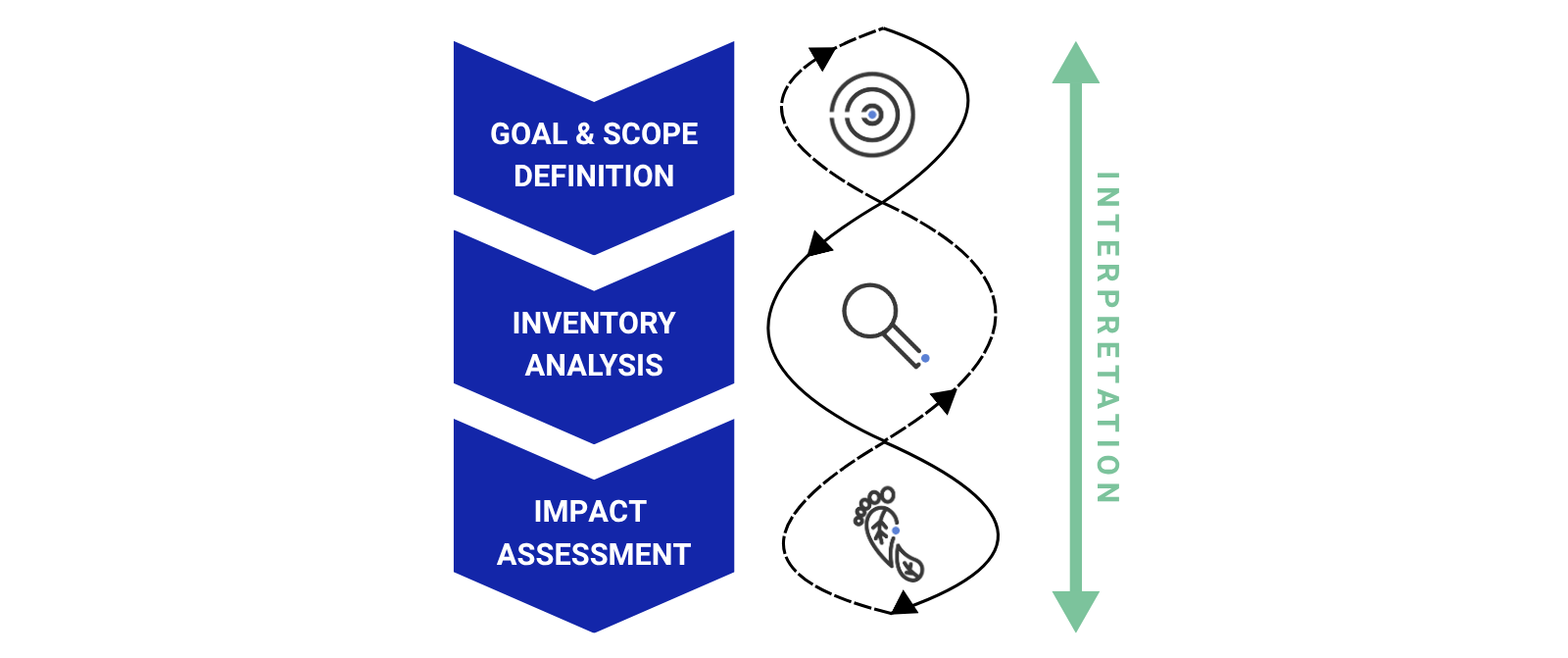
LCA is based on four key steps:
- Define the objectives and scope of the study
- Collect data on materials and energy, consumption of reagents, other manufacturing aids, and waste emissions in all forms
- Assess environmental impacts according to different impact categories, not limited to global warming, using impact data from internationally recognized databases
- Interpret the results to guide design choices.
In the process industry, LCA is a strategic decision-making tool. In concrete terms, it offers several levers to guide industrial choices:
- Integrate eco-design from the earliest stages, on the same level as technical and economic feasibility
- Identify environmental hot spots to prioritize optimizations, and do so as early as possible to optimize development times
- Compare several process alternatives in order to make informed choices
- Strengthen industrial competitiveness while improving sustainability
By integrating these principles from the R&D stage onwards, companies can design more efficient, sustainable, and competitive processes.
At Processium, we offer LCA as an integrated part of our process development studies. Our approach stands out for the quality and consistency of our inventories, which form the foundation of a reliable and relevant LCA.
Each LCA is conducted by an experienced process engineer trained in the use of LCA tools, following a methodology based on ISO 14040/14044 standards. This approach guarantees:
- Comprehensive and realistic inventories, even at an early stage of development, thanks to physicochemical modeling (Aspen, ProSim, e-thermo)
- Systematic verification of data consistency, ensuring coherence between material, energy, and process performance balances
- Contextualized interpretation, aligned with the customer’s performance and industrial feasibility objectives
- Seamless integration with technical and economic analysis (TEA) to cross-reference environmental impacts and economic viability
At Processium, LCA has become a decision-making engineering tool that can be used directly by R&D teams and development managers.
The main advantage of LCA lies in its multi-criteria approach, which prevents impacts from being transferred from one stage or parameter to another. Thanks to the rigor of our inventories, Processium helps its clients to:
- Identify priority trade-offs
- Understand the transfer of impacts between different solutions
- Inform the design of more sustainable and efficient processes
At Processium, we firmly believe that eco-design should not be an environmental overlay applied at the end of a project. It must be integrated from the modeling stage onwards, in line with profitability, technical feasibility, and regulatory compliance.
With our LCA + TEA (technico-economical assessment) approach, we enable our clients to:
- Design more efficient and circular processes
- Secure their choices from the R&D stage onwards
- Strengthen their applications for funding and certification